

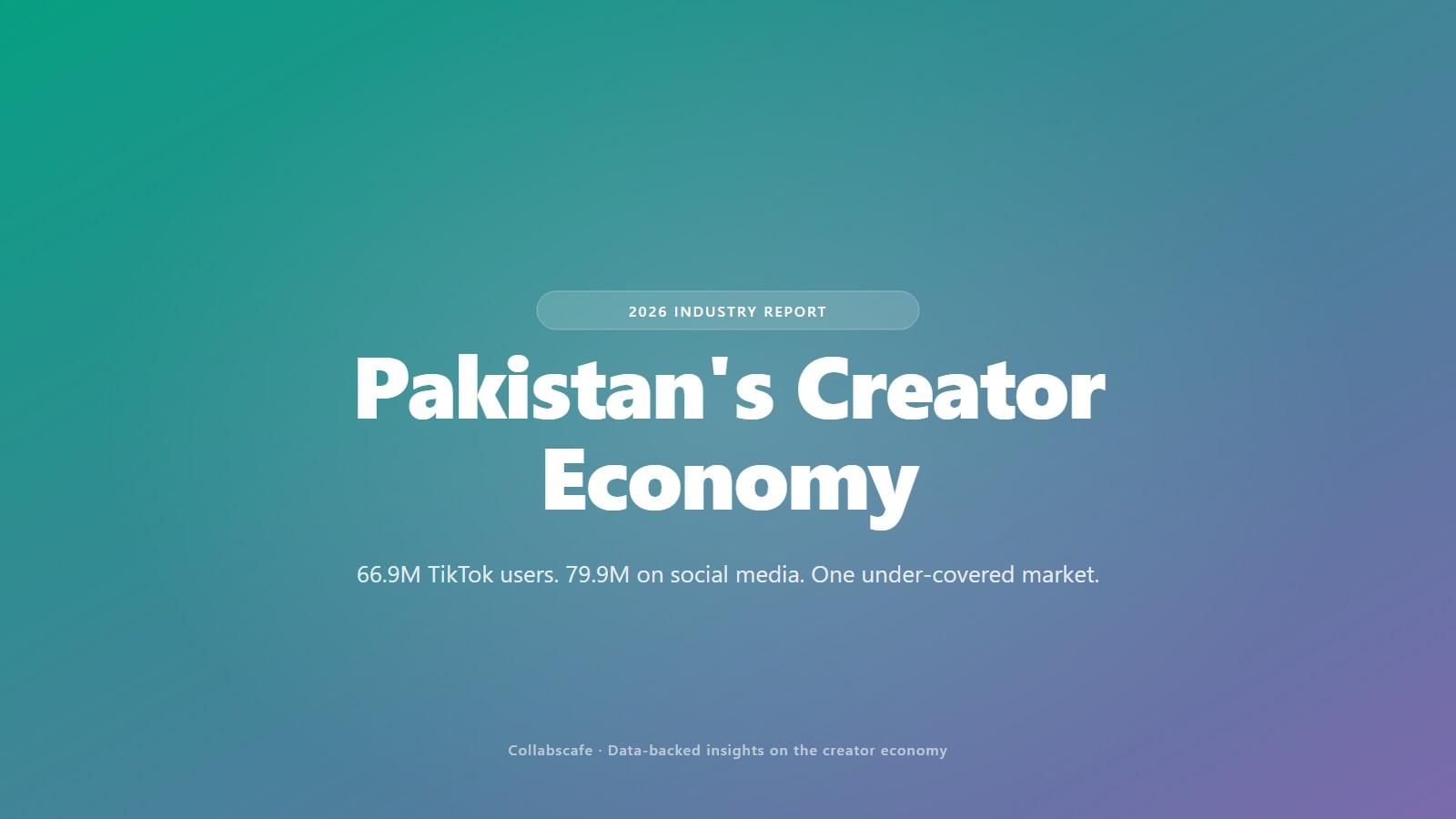
Pakistan has quietly become one of the largest and most under-covered creator markets in the world. 66.9 million people use TikTok. 79.9 million use social media in some form. 117 million are online. The country ranks third globally for TikTok app downloads in recent quarters, ahead of most European markets and behind only two other countries.
Yet almost no serious analysis of Pakistan's creator economy exists in English. Global industry reports mention Pakistan in passing, if at all. Regional coverage treats it as a footnote to India. This article is the baseline attempt to change that: what the numbers actually say, what platforms creators actually use, what tiers dominate, and what brands need to understand before they spend money.
All data below is from public sources, cited at the end. No Collabscafe internal numbers are used.
The core numbers, one place
Here is the baseline as of early 2026, from DataReportal and cross-referenced industry sources.
| Metric | Value | Notes | |--------|-------|-------| | Internet users | 117 million | ~45.6% penetration | | Social media user identities | 79.9 million | ~31.2% of population | | TikTok active users (18+) | 66.9 million | Largest single platform | | Global TikTok download rank | 3rd | Behind US, Indonesia | | Adult TikTok penetration | 46.3% | Of all Pakistani adults | | Concentrated age band | 18-34 | Prime consumer bracket |
For context: Pakistan's TikTok user base is roughly the same size as Germany, France, and Italy combined. It's more than three times the population of Saudi Arabia. And it's growing faster than every established Western market.
Why Pakistan matters more than brand marketers realize
Three factors make Pakistan's creator economy structurally significant, not just numerically large.
1. The demographic concentration
TikTok's user growth in Pakistan is heavily concentrated in the 18-34 age band. This is the demographic with the fastest purchasing power growth and the highest lifetime value for most consumer brands. It's also the demographic most receptive to creator-led buying decisions and least trusting of traditional advertising.
For brands targeting anything young-adult adjacent (fashion, beauty, tech, food, fitness, entertainment), Pakistan represents a market where the buying demographic and the content demographic overlap almost completely.
2. The platform mismatch
Pakistan's creator economy runs on TikTok in a way most Western brand marketers still don't fully grasp. TikTok is not "one of several platforms" here. It is functionally the default social platform for the largest single demographic in the country. Instagram is meaningful. YouTube is meaningful. Facebook is culturally embedded, especially for older users. But TikTok is where the volume and the recent growth is.
Global influencer budgets, meanwhile, still favor Instagram slightly. The 2026 industry split has TikTok at around 35% and Instagram at around 33% of global influencer spend. In Pakistan specifically, that ratio should skew heavier toward TikTok, which creates a modest arbitrage window: TikTok creators in Pakistan are relatively under-monetized by global comparison.
3. The under-coverage advantage
Because the industry writes about Pakistan sparingly, most competitive intelligence for brands entering Pakistan is either outdated or absent. Rate cards are inconsistent. Vetting processes are ad hoc. Contracts are informal. Any brand that structures its Pakistan creator work with discipline is competing against a market where most other brands are winging it.
Platform breakdown: where creators actually are
The order below reflects Pakistan-specific usage patterns, not global averages.
TikTok
The dominant platform. 66.9 million users. Highest growth rate. Most engagement across all creator tiers. Fastest content velocity. Most creator-native economy: TikTok creators are more likely to have monetization as a stated goal from the start, unlike Instagram creators who often built pre-monetization followings.
For brands: TikTok is where video-first, short-form, product-integrated campaigns actually work in Pakistan. The algorithm still pushes content beyond followers, which means a well-briefed campaign with a mid-tier creator can outperform a poorly-briefed campaign with a mega creator.
Meaningful but not dominant. Instagram in Pakistan runs closer to the global norm: creators tend to be older, campaigns tend to be more polished, and Reels have partially eaten the Feed's engagement share.
For brands: Instagram works well for brand-safe, aesthetic-driven campaigns and for creators whose audiences skew slightly older than TikTok's. Product tutorials, lifestyle content, and mood-heavy campaigns land well.
YouTube
The most under-utilized major platform in Pakistan. Long-form YouTube creators exist but the platform is dominated by entertainment (music videos, comedy, drama clips) more than product-focused creator content. YouTube Shorts is closing the gap with TikTok in raw view volume but not in commerce integration.
For brands: YouTube works for education-heavy or high-consideration purchase categories (tech, finance, education products, longer product demos).
Still culturally embedded, especially for 30+ demographics and small-business commerce (Facebook Marketplace remains a serious shopping channel in Pakistan). Facebook is less relevant for brand-creator campaigns targeting youth but still meaningful for community-driven brand-building.
The creator tiers landscape in Pakistan
Global influencer marketing categorizes creators by tier. Pakistan's tier distribution differs from Western norms in specific ways.
| Tier | Follower range | Pakistan characteristics | |------|----------------|--------------------------| | Celebrity | 1M+ | Concentrated in entertainment, cricket, and TV. Fewer purely-native creators than in the US market. | | Mega | 100K-1M | The biggest single opportunity for brands. Broader creator diversity than the celebrity tier. Rate cards vary wildly. | | Macro | 50K-100K | Sweet spot for high-reach product campaigns. Most likely tier to have professional management. | | Micro | 10K-50K | The heart of the creator economy. Highest volume of active creators. Best engagement-to-cost ratio for most brand campaigns. | | Nano | 1K-10K | Explosive growth tier. Highest engagement rates. Best for hyperlocal or niche campaigns. |
The two most under-invested tiers globally are micro and nano. Both are dominant in Pakistan's creator economy by count. Global data shows nano creators averaging around 8.3% engagement rate versus 4.1% for mega. Micro-influencer campaigns consistently deliver 60% lower per-post costs versus mega, with higher ROI.
The single most efficient tier for a brand's first Pakistan campaign is micro (10K to 50K followers). Enough reach to matter, high engagement, and rate cards that don't require enterprise budgets.
What brands are actually spending
Public data on Pakistan-specific creator spend doesn't exist at the granularity of US or European markets. What can be said with confidence:
- Global influencer marketing was estimated at $21 to $24 billion in 2026, growing 15-20% year-over-year.
- TikTok's share of global influencer spend has grown from under 5% in 2019 to 25-35% in 2026, with continued outperformance versus the broader market.
- Pakistan-specific spend is likely 5-10x smaller than India per capita adjusted, but growing faster in absolute terms as more brands localize campaigns.
The dynamic that matters for Pakistan brands specifically: creators in Pakistan can be booked for significantly less in USD terms than their Instagram or TikTok follower count would suggest under Western rate cards. This isn't a moral point, it's an arbitrage: a brand entering the Pakistan market can secure creator partnerships at rates that would be impossible in the US, UK, or Europe.
The five trends shaping the next 12 months
1. AI + audience verification becomes a hiring standard
Fake follower audits, engagement-quality signals, and audience-authenticity checks are moving from optional to default. Brands increasingly refuse to book creators without some form of verification signal on the profile. This is a structural shift, not a fad. It's why we built TrustLens AI into every creator profile on Collabscafe, and it's why brand-side buyers are expecting similar visibility from every platform they evaluate.
2. UGC is eating classic sponsored posts
Brands are shifting budget away from single sponsored posts and toward user-generated content produced by creators and reused as paid ad creative. The trend is global but is playing out in Pakistan with a specific twist: Pakistani UGC creators are often willing to produce for lower rates than their follower count would command in the US, which makes Pakistan an attractive market for brands sourcing UGC to run globally.
3. Micro and nano dominate booking volume
The center of gravity keeps moving down the tier ladder. Global data shows micro-influencers delivering higher ROI at 60% lower cost. In Pakistan, where mega creator rate cards are still catching up to Western equivalents, micro remains the most efficient tier for brand campaigns. Most brand campaigns will book micro or nano creators for the majority of their budget.
4. Cross-platform creators become the norm
The Pakistani creator who exists only on one platform is becoming rare. Creators increasingly manage Instagram + TikTok + YouTube presences in parallel, sometimes with different audiences on each. Brands that structure campaigns around one platform miss the compounding effect of a creator's cross-platform reach.
5. Local brand + regional creator campaigns increase
Pakistani brands are starting to book creators from outside their immediate city or region for campaign diversity. A Karachi brand booking a Lahore-based creator, or a national brand booking creators in five cities for regional campaigns. This is only possible because platforms now make cross-city creator discovery straightforward. Regional campaign patterns will grow through 2026 and 2027.
What this means for brands
Three things follow from this data.
First: if your brand's target consumer is Pakistani, TikTok is not optional. Instagram and YouTube supplement TikTok, they don't replace it. Any campaign design that treats TikTok as one of several platforms is starting from a wrong prior.
Second: the micro tier is your most efficient default. Nano for hyperlocal campaigns, macro for broad-reach launches, but micro is where the ROI is most reliably positive for brands running their first Pakistan-specific campaigns.
Third: audience verification is the highest-leverage single change you can make to your current process. Fake follower issues in Pakistan are no worse than global averages, but the tooling to catch them has been so poor that most brands book blind. That's changing. Adopting a platform or workflow with audience verification built in removes the largest single source of campaign failure.
For a deeper explanation of how audience verification actually works, see our TrustLens AI guide. For the specific mechanics that prevent the failure modes described here, see The Real Cost of a Bad Influencer Campaign. And if you want to skip straight to the creators actually driving this market, see our top 20 Pakistani creators with 100K to 1M followers.
What we're watching for 2027
Six things to track for next year's edition of this report.
- TikTok user growth in Pakistan: does it continue to outpace the global average, or does it hit a ceiling?
- Instagram Reels engagement in Pakistan: will Reels catch up to TikTok on native engagement?
- YouTube Shorts monetization for Pakistani creators: a promising growth vector.
- Rate card professionalization: will Pakistani creators move toward transparent published rates, or continue to negotiate case-by-case?
- AI content and creator disclosure: how the market handles AI-generated content by human creators.
- Regional MENA expansion: Pakistani creators booking campaigns from Saudi Arabia, UAE, and Kuwait brands, and vice versa.
Sources and methodology
All statistics cited in this article are from publicly available sources:
- DataReportal Digital 2026: Pakistan: the primary source for Pakistan-specific social media user counts, internet penetration, and demographic breakdowns.
- Global TikTok statistics for 2026 as compiled by multiple industry researchers including MediaMister, ResourceEra, and DesignsFirm covering user counts, engagement rates, and country rankings.
- Global influencer marketing industry size from The Influencer Marketing Factory, Digital Applied, and other industry aggregators.
- TikTok's global ad spend share as reported by multiple industry sources for the 2026 fiscal year.
- Engagement rate benchmarks by tier from global industry sources.
The interpretation, framing, and specific trends called out reflect the author's perspective as founder of a Pakistan-focused creator marketplace. No proprietary or internal Collabscafe data is used in this report.
To see how Pakistan's creator economy looks from the inside, browse the Explore page to see creators, or read the What is Collabscafe? guide for context on how the platform is built.