

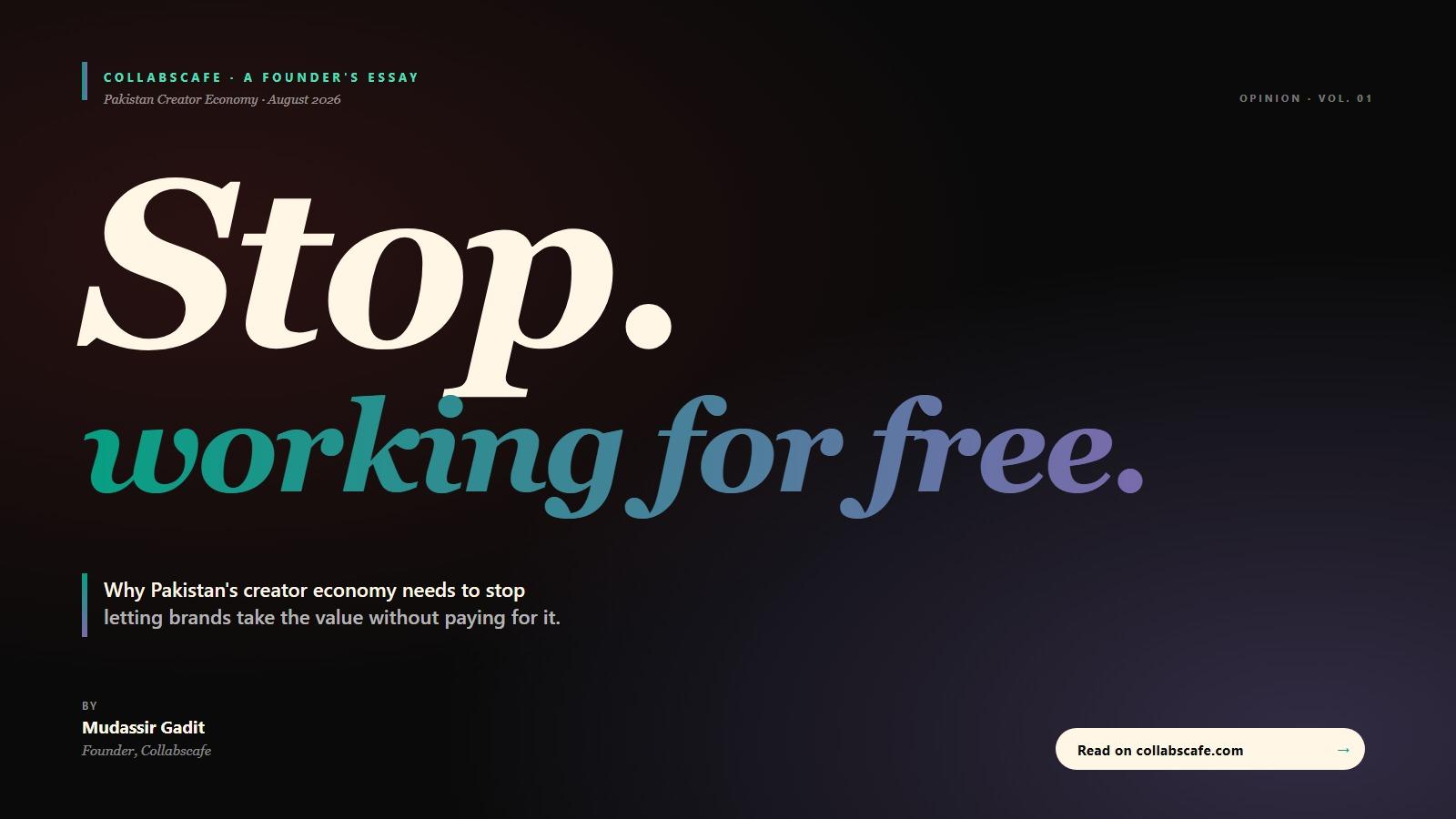
The most expensive word in Pakistan's creator economy is free. It's what brands offer creators. It's what creators offer up to compete. It's what everyone accepts as normal. And it's what makes the whole system poorer, not richer.
This is not an abstract argument. Every week, hundreds of Pakistani creators are asked to work for free. It gets dressed up as barter, or exposure, or seeding, or collab opportunity. The nouns change. The economics don't. A creator produces content, a brand takes the value, and the money that should flow between them never does.
I am done pretending this is fine.
The math nobody does
Here is what a "barter collab" actually costs at nano tier.
A brand offers a 1K-10K follower creator a product worth PKR 500 in exchange for one Reel plus one Story. The creator says yes because barter is the default and refusing feels like refusing a foot in the door. The brand thinks it just got a Reel for free.
Neither is true.
That Reel is one to three hours of production time from the creator: shot planning, filming, editing, captioning, posting, community reply. The Story is another twenty minutes. The creator is also handing the brand permanent placement in her feed for as long as her account stays live. On any hourly-rate calculation, that Reel is easily PKR 3,000 to 8,000 of extracted labor. The product is worth PKR 500.
The creator lost 4,000 rupees of value in that exchange. She just doesn't have a spreadsheet showing it.
Multiply that across thousands of barter collabs happening across Pakistan this month. The extraction is not small. It is the largest hidden wealth transfer in the country's creator economy.
Why "free" is not free for brands either
The counterintuitive part: barter campaigns are worse for brands too. Not morally. Economically.
Content produced under barter is measurably weaker than paid content. Creators who are not paid put in less effort, defensibly. They spend less time on production, script, hooks, and lighting. They cannot be held to a professional deliverable standard because you are not paying professional rates. When you ask for revisions, they can walk away with no penalty because the exchange was already unequal.
The result: the brand gets a lower-quality asset that performs worse than an equivalent paid Reel would have, using an audience that trusts the creator slightly less because the audience can smell an obligated post. Then the brand looks at the analytics and concludes influencer marketing does not work in Pakistan. It works. It just does not work for free.
The real cost of a "free" campaign is not zero. It's the difference between the flat performance you actually got and the paid campaign you did not run.
The trap creators walk into
Barter feels like a starting rung. It is not. It is the ceiling in disguise.
Once a creator accepts one barter deal, that deal becomes the reference point for the next brand approaching her. The second brand offers barter too, or offers a small cash top-up above the product. The third brand asks for two deliverables in exchange for one product because the first two brands got away with one. The fourth brand offers exposure. Ten collabs in, the creator has learned that her rate is whatever the market gives her, which is next to nothing.
This is the ratchet. Creators do not price themselves up from barter. Barter drags their published rate down.
Then a fifth brand comes along and offers actual cash, PKR 5,000 for a Reel. The creator is grateful and takes it. Five thousand rupees for two hours of skilled work and use of the audience she spent two years building. That is not a starting rate. That is a sub-minimum wage in disguise, dressed as opportunity.
This is how creator economies stay small.
The industry effect
When enough creators accept barter, the whole tier's rate card collapses.
Nano goes first. Micro follows because brands see nano rates and expect similar economics from the next tier. Macro tightens because brands trained on cheap nanos and micros push the same expectations upward. The mega and celebrity tiers remain paid, but they get hoarded by the same twenty faces because the middle of the market never gets to develop into a professional class.
The end state, which Pakistan is uncomfortably close to, is an economy with a hundred paid mega creators at the top and everyone else fighting for scraps. That is not a creator economy. That is a lottery.
The professionalized version, the one every mature market has, looks different. Nanos have real rate cards. Micros have contracts. Macros have management. Mega creators still get paid the most but not because they are the only ones getting paid. The whole ladder functions.
Pakistan has the talent, the demographic, and the platform behavior to build the professionalized version. What we do not yet have is the pricing culture. That is the fix.
What paid-first looks like
Six things change when a market shifts from barter-default to paid-first.
Rate quotes come first, not last. The first message from a creator to a brand includes a starting rate. The first message from a brand to a creator includes a budget. Neither side wastes time on "let's discuss" pretending money is a taboo.
Product seeding gets separated from paid content. A brand sending a product to a creator either sends it as a genuine gift with no expectation of content, or sends it as part of a paid contract. The middle ground where creators feel silently obligated to post disappears.
Rate cards are published. Not because publishing them is safe. Because publishing them is what stops the individual negotiation ratchet. If a creator's rate is PKR 15,000 for a Reel, it is 15,000 for every brand, and there is no negotiation floor below that number.
Contracts, not WhatsApp messages. Even a two-line email contract creates enforceability. A voice note does not.
Revisions are scoped and paid. Two revisions included, additional revisions charged. This alone eliminates the biggest source of unpaid creator labor.
Payment goes through escrow. Not because brands are inherently untrustworthy. Because escrow removes the collection risk that lets brands slow-pay creators for months after delivery.
Every one of these is a small structural change. None of them require government policy, industry alliance, or platform coordination to work. Any brand and any creator can adopt every one of these six practices this week.
What brands can do this week
Five moves that unilaterally shift your own campaigns without waiting for the industry to catch up.
- Set a minimum PKR floor for any collab. Even PKR 3,000. If a creator is worth the collab, they are worth cash. If they are not worth cash, they are not worth the collab.
- Publish your budget upfront. In the first outreach message, name the range. It saves everyone's time and shows respect.
- Offer paid-first, not barter-first. Reserve barter for genuine no-post gifting.
- If you must seed, decouple it from the post. Send the product. Do not expect content. Ask separately if they want to run a paid collab.
- Contract in writing. One-page contract. Deliverables, deadline, revisions, payment terms. That is it.
None of these cost more money over time. Point five saves you money the first time a dispute happens.
What creators can do this week
Three moves that individually shift the ratchet in the right direction.
- Set a public rate card. Even a modest one. Even if you have never charged before. A published number stops the individual negotiation collapse before it starts.
- Refuse barter-only deals if the math does not hold. Calculate the hourly value. If a "free" collab pays you less than what you value an hour of your time at, decline. Politely.
- Track what you actually earn per hour. Include shoot time, edit time, community reply time. Most nano creators realize they have been earning under PKR 200 per hour of skilled work. That is data. Use it.
None of these require you to be a mega creator. They require you to price yourself like a professional, not a hobbyist.
What Collabscafe is building
I am not going to pretend this article is neutral. We are building a marketplace where paid-first is the default, not the exception. Every collab runs through escrow. Every profile shows published rates. Every creator gets a TrustLens AI audience card so brands know audience quality before they pay. Contract terms are structured, not free-form.
None of that eliminates barter culture on its own. What it does is create infrastructure that makes paid-first easier than the alternative, which is the only way any market shifts.
We are the smallest force in this equation. Brands, agencies, and creators together set the culture. What we can do is remove the friction that has kept the paid-first version of Pakistan's creator economy from emerging. That is the work.
The close
Pakistan has world-class creators. They deserve a world-class market.
Barter culture is not a starting point that graduates people to paid. It is the ceiling that keeps most of the industry stuck. Every creator that accepts unpaid work ratchets the entire tier down. Every brand that offers unpaid work trains the next brand to do the same.
Stop working for free. Stop asking creators to work for free. Start pricing labor like the professional labor it is.
The industry that comes out the other side pays more, produces better content, and builds bigger brands. That is not a moral argument. That is an economic one. The moral argument is separate, and it is that creators are workers, and workers deserve to be paid.
Related reading
- Pakistan Influencer Rates 2026: What Creators Actually Charge: the paid tier ranges the barter default is undercutting.
- Pakistan Creator Marketing Playbook for Brands 2026: how to structure a paid-first campaign.
- The Real Cost of a Bad Influencer Campaign: why cheap campaigns are the most expensive kind.
- State of Pakistan's Creator Economy 2026: the market data behind why this shift matters right now.
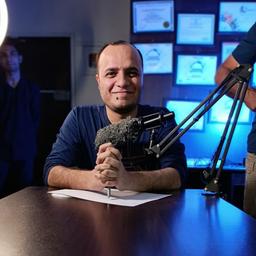
Written by Mudassir Gadit, founder of Collabscafe. Disagreements welcome; that's how the industry conversation moves. Reach out on LinkedIn or via collabscafe.com.