

Last week's State of Pakistan's Creator Economy 2026 covered the numbers: 66.9 million TikTok users, 79.9 million on social media, one under-covered market. This week is the follow-up brands actually need: what to do about it.
This playbook is written for anyone running their first, second, or fifth Pakistan influencer campaign. It skips the theory and gives you the decisions you have to make, in the order you have to make them, with the specific tradeoffs that trip brands up.
The seven decisions that make or break your campaign
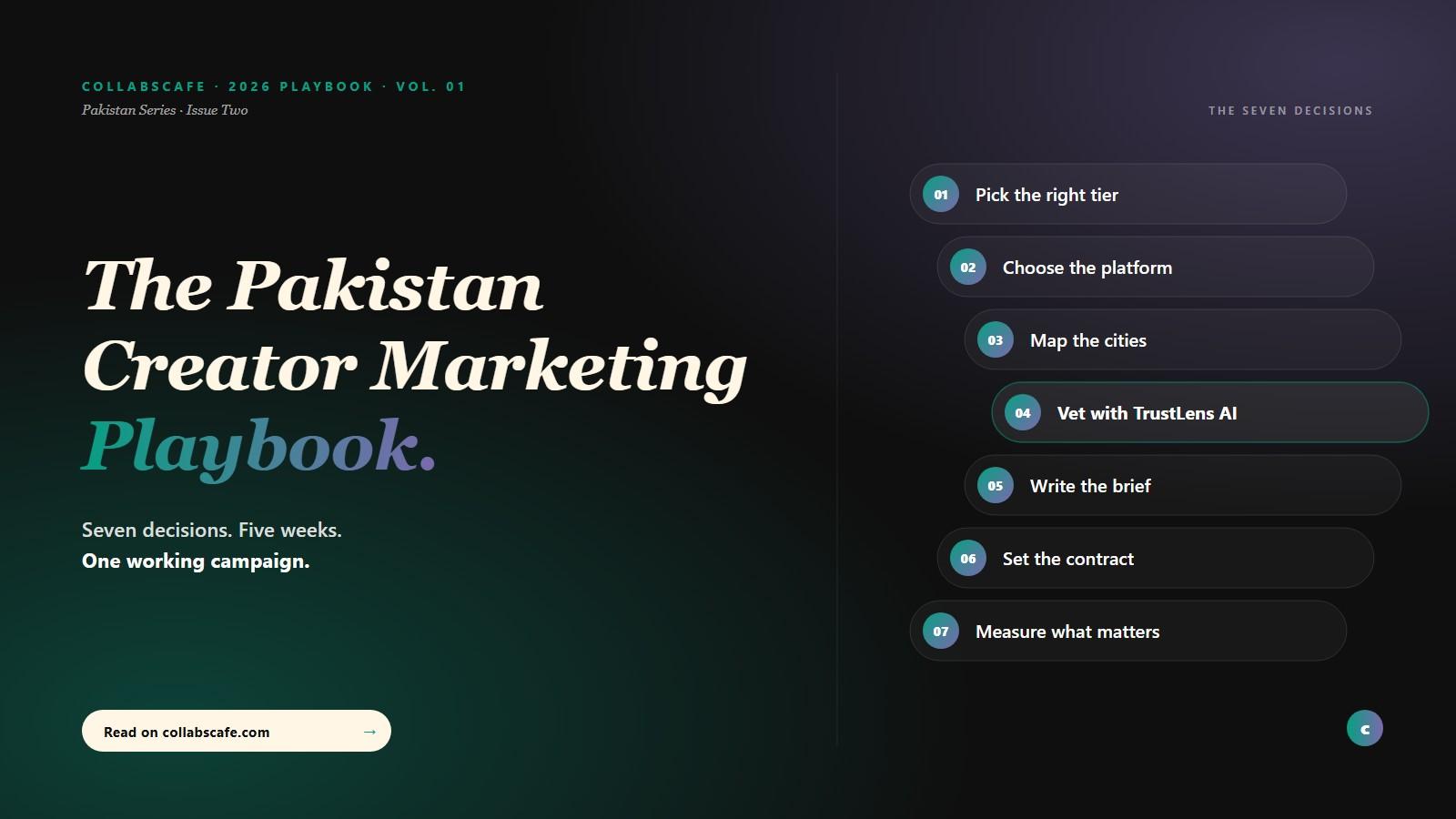
Every Pakistan campaign is a sequence of seven decisions. Get all seven right, you have a working campaign. Get one wrong, and the campaign underperforms no matter how much you spend.
- Which tier of creator?
- Which platform?
- Which cities or regions?
- How do you vet them?
- What does the brief say?
- What contract structure?
- How do you measure success?
The rest of this playbook walks each one, in order.
Decision 1: Which tier
Pakistan has the same tier structure as global influencer markets, but the rates and the sweet spot are different.
| Tier | Followers | Typical PKR per post | Best for | |------|-----------|----------------------|----------| | Nano | 1K–10K | PKR 3,000–15,000 | Hyperlocal, niche, product seeding | | Micro | 10K–50K | PKR 15,000–75,000 | First campaigns, product launches, high ROI | | Macro | 50K–100K | PKR 50,000–200,000 | Broader reach, category launches | | Mega | 100K–1M | PKR 150,000–800,000 | National awareness, hero content | | Celebrity | 1M+ | PKR 500,000+ | Category-defining campaigns, prestige plays |
Rates vary heavily by niche and platform. Beauty and fashion carry premium rates. Tech and finance often carry discounts because the audiences are smaller but higher-value. TikTok rates trend below Instagram at the same follower count in most niches, though TikTok is closing the gap fast.
The Pakistan sweet spot for most brands is micro (10K–50K). Enough reach to matter, high engagement, rates that let you book three creators for the price of one mega. If it's your first campaign, start here.
Decision 2: Which platform
Pakistan's platform mix is different from global norms. Instagram is not automatically the default. TikTok is not automatically the discovery engine. It depends on your audience and category.
TikTok: default for youth-adjacent categories (18–34). Fastest content velocity, highest engagement per post, algorithm still pushes discovery beyond followers. Best for beauty, fashion, food, fitness, entertainment. UGC campaigns work particularly well here.
Instagram: meaningful for aesthetic-driven categories and slightly older audiences (25+). Reels and Feed both work. Story campaigns are cheaper but less measurable. Best for lifestyle, home, luxury, aspirational fashion.
YouTube: under-utilized for creator marketing in Pakistan but strong for education-heavy or high-consideration categories. Tech, finance, education products, and longer product demos land well. YouTube Shorts is a growth vector to watch.
UGC (user-generated content): technically not a platform but a deliverable format. UGC creators produce content you use in your own paid ads. Pakistani UGC creators are often willing to produce at lower rates than their follower count would command in the US, which makes this an attractive vector for global brands.
Multi-platform is the norm now. A well-briefed creator often produces one Reel for Instagram and one video for TikTok from the same shoot. Ask for both in a single brief and you double your reach without doubling your rate.
Decision 3: Which cities
Karachi, Lahore, and Islamabad dominate creator supply. Roughly 70 to 80 percent of listed creators come from these three cities. But city selection matters more than most brands realize.
- Karachi: biggest creator pool, most diverse categories, strongest for fashion and beauty. Rates trend highest here. Best for national brands that want commercial appeal.
- Lahore: strong across all categories, particularly food, entertainment, and lifestyle. Cultural production hub. Rates slightly below Karachi.
- Islamabad and Rawalpindi: growing fast, strong for tech, education, and business content. More conservative aesthetic on average.
- Faisalabad, Multan, Peshawar, Sialkot: emerging creator markets. Fewer creators available but rates are significantly lower and audience-city match is powerful for regional campaigns.
If you're a Karachi-based brand targeting Karachi consumers, don't only book Karachi creators. Book one from each of the three major cities. It costs the same and gives you a much better read on which market resonates.
Decision 4: How to vet
This is where brands lose the most money on Pakistan campaigns. Rate cards don't have quality signals attached. Follower count doesn't equal audience quality. A creator with 200K followers can have 15 percent bot traffic, and you'd never know from their profile alone.
The vetting checklist we recommend:
- Engagement rate check. Divide average likes by follower count. Below 1 percent is a red flag on Instagram. Below 3 percent is a red flag on TikTok. Above 8 percent for a mega creator is suspicious in the other direction (either bought engagement or a very small but very active audience).
- Follower authenticity. Look at the last 20 comments on any post. If they read like "great post 🔥🔥🔥" from bot-named accounts, the audience is likely padded. Real audiences comment specifically.
- Audience location. For a Pakistan campaign, at least 60 percent of the audience should be in Pakistan. Some creators have followers heavily in India, Bangladesh, or the Middle East, which sounds good but doesn't convert.
- Growth pattern. Steady growth is healthy. Sudden spikes without a corresponding viral post are a bought-follower signal.
- Content freshness. Creators who post twice a week for 12 months are lower risk than creators who posted 40 times last month and nothing for the six months prior.
Doing this manually per creator takes an hour each. This is why every profile on Collabscafe carries a TrustLens AI audience analysis — the same checks compressed into signals you can read in 30 seconds.
Decision 5: What the brief says
Bad briefs are the single most common cause of campaign underperformance. Creators produce what they are asked to produce, and vague briefs get vague content.
A good Pakistan creator brief includes:
About the brand: two sentences. What the brand does, who the target consumer is.
About this campaign: one line. What you want the audience to do after seeing the content. "Buy a bottle of our new hair serum" is a good campaign goal. "Increase brand awareness" is not.
Deliverables: exact counts. "2 Reels, 3 Stories, 1 Grid post" beats "some Reels and Stories."
Tone and voice: what feels wrong. If the brand is playful, say "no corporate tone, keep it casual." If the brand is premium, say "no memes, no emojis in captions."
What to include: the 3 to 5 things that must be in the content. Product shot, tagline, call to action, hashtag, disclosure that this is a paid collab.
What to avoid: just as important. Competitor mentions, controversial topics, specific colors or styles that clash with the brand identity.
Timeline: when the brief was sent, when the draft is due, when the final delivery is due, when the content should go live.
Rights: who owns the content after publication. Standard is creator owns, brand gets limited-time repost rights. If you want to run it as a paid ad, negotiate that upfront.
One brief per campaign, not one per creator. Write the master brief once, adapt it per creator with two or three lines specific to them. This scales without eating up your day.
Decision 6: What contract structure
Pakistan influencer contracts are still mostly informal. Most creators work off WhatsApp agreements and screenshots. For anything over PKR 25,000, that's a mistake.
The minimum a written contract should specify:
- Deliverables: counts, formats, platforms.
- Timeline: shoot date, delivery date, go-live date.
- Payment: amount, currency, when it's paid (before delivery, on delivery, or after).
- Revisions: how many rounds. Two is standard.
- Rights: publishing rights, ad rights, exclusivity if any.
- Kill fees: what happens if the brand cancels after the shoot but before publication.
- Disclosure: confirmation that the creator will disclose the collaboration per platform rules.
The escrow-protected payment structure that platforms like Collabscafe offer removes most of the friction here. Payment is held securely until the content is delivered and approved, so neither side is exposed to the other's default risk.
Decision 7: How to measure
Measurement is the hardest single problem in creator marketing. Not because the metrics don't exist, but because different metrics tell different stories and brands often measure the wrong one.
The right measurement stack depends on the campaign goal.
For awareness campaigns: measure reach and impressions. Views on the specific piece of content, not follower count. A creator with 50K followers whose post gets 200K views delivered you 200K impressions, not 50K.
For engagement campaigns: measure comments, saves, and shares (not likes). Likes are the cheapest signal to fake and the least meaningful to spend on. Saves and shares are the ones that predict downstream purchase behavior.
For conversion campaigns: use unique tracking links or discount codes. Every creator gets a different code. You can then attribute revenue to individual creators. This is the only measurement approach that gives you clean ROI data.
For growth campaigns: measure follower gain on your own brand accounts in the 48 hours after the creator's post goes live. Isolate the creator's contribution by comparing to your baseline growth.
Do not try to measure everything at once. Pick the one metric that matches your goal and let the others be secondary.
The five most common failure modes
Over the past 18 months of building Collabscafe and watching thousands of Pakistan creator campaigns run through the platform, five failure modes account for the majority of what goes wrong.
1. Booking the biggest creator you can afford. Mega creators are expensive per view and often have padded audiences. Three micro creators for the same budget usually outperform one mega, with better engagement and better targeting.
2. Vague briefs. "Talk about the product and be authentic" produces content that doesn't sell. Specific briefs produce specific results.
3. No disclosure requirements. Pakistani ad law and platform TOS both require creators to disclose paid collaborations. Skipping this saves nothing and exposes the brand to platform enforcement (content takedowns) and reputational risk.
4. One-shot campaigns. A single post rarely moves the needle. Same creator, three posts across a week outperforms three different creators posting once, in most cases, because audiences need repetition to convert.
5. Measuring by likes. Likes are the cheapest and most manipulable signal on any platform. Every campaign should have at least one measurement metric that isn't likes.
The five-step launch checklist
You have your seven decisions. Here's the sequence to actually execute a campaign, start to finish.
- Week 1 — Discovery and shortlist. Identify 15 creators that could fit. Vet them (TrustLens AI signals, engagement rate, audience geo). Narrow to 5.
- Week 2 — Contact and negotiate. Send briefs, get rate confirmations, sign contracts. Book 3 creators.
- Week 3 — Production. Creators shoot content. Draft reviews at the end of the week. One round of revisions if needed.
- Week 4 — Publication. Content goes live across the three creators. Boost the best-performing posts as paid ads. Monitor real-time engagement.
- Week 5 — Measurement and learning. Pull performance data. Attribute revenue via tracking links. Write a one-page campaign report. Book the top performers again for the next cycle.
Five weeks, three creators, one working campaign. This is the smallest useful unit of Pakistan creator marketing.
What this looks like on Collabscafe
Every step above compresses on Collabscafe:
- Discovery: filter creators by niche, city, platform, follower band, and budget in one search. Filter panel is on the Explore page.
- Vetting: TrustLens AI signals show on every profile. No manual audit needed.
- Brief and contract: built into the creator workspace. Deliverables, timeline, and rights all live in one place per collaboration.
- Payment: escrow-protected. Money is held safely until you approve the delivered content.
- Measurement: track deliverables and revisions in the workspace; attribute revenue via your own analytics.
The playbook works whether you run it on your own or on a platform. It's just faster and less error-prone in a workspace built for it.
Sources and related reading
- Top 20 Pakistani Creators with 100K to 1M Followers: the shortlist that puts this playbook into practice — 20 macro-tier creators ready to book.
- State of Pakistan's Creator Economy 2026: the data report this playbook builds on.
- The Real Cost of a Bad Influencer Campaign: deeper dive into failure modes 1 through 5.
- What is TrustLens AI: how the audience-quality signals in decision 4 actually work.
- Who is Collabscafe For: the personas this playbook was written for.
For public reference data on the tiers, rates, and behaviors described, see DataReportal Digital 2026: Pakistan, and industry benchmarks compiled by the Influencer Marketing Factory and Modash for 2026.
Ready to run your first campaign? Browse vetted creators on Collabscafe or read who Collabscafe is built for if you're not sure it's the right fit.